


ICSE Class 6 Complete Program: Mathematics + Physics + Chemistry + Biology
One program. Four subjects. Full syllabus coverage. Give your child the confidence to master Integers, Algebra, Forces, Elements, States of Matter, Light, Magnets, Plants, Human Body, and more - with clear, concept-based teaching.

The "Class 6 Leap"
Why Class 6 is the Most Critical Year for Maths & Science
Until Class 5, Maths was mostly arithmetic and basic shapes; Science was fun facts. Class 6 ICSE changes everything
In Maths, your child suddenly faces:
- Negative numbers and integers
- HCF & LCM using prime factorization
- Ratio (comparison by division, not subtraction)
- Algebra with variables and simple equations
- Geometry constructions using compasses
- Volume of cubes and cuboids
In Physics: Measurement, forces, friction, simple machines, light (rectilinear propagation, eclipses), magnets.
In Chemistry: What is matter? Elements vs compounds vs mixtures, separation techniques, states of matter, effect of heat.
In Biology: Living vs non-living, plant parts & photosynthesis, animal classification, human digestive & respiratory systems, health.
At Core Concept Tutorials, we offer a complete, integrated program covering all four subjects – saving parents time, money, and the headache of coordinating multiple tutors.
The Complete Syllabus We Cover (Year-Long Program)
📐 MATHEMATICS (Full ICSE Class 6 Syllabus)
| Theme | Key Topics |
|---|---|
| Number System | Integers (negative numbers, ordering, addition, subtraction), HCF & LCM (prime factorization & division method, LCM×HCF = product), fractions (proper/improper/equivalent, addition/subtraction of like/unlike fractions), decimals (operations, real-life use in money/length) |
| Ratio & Proportion | Ratio vs fraction, proportion as equality of two ratios, percentage (fraction with denominator 100), speed-time-distance (simple daily life problems) |
| Algebra | Variables & unknowns through patterns (e.g., sum of odd numbers = n²), algebraic expressions (terms, coefficients, like/unlike terms), evaluation of expressions, linear equations (one operation: x+6=10, 2x=8, x/2=5) |
| Geometry | Line, line segment, ray, open/closed figures, interior/exterior, angle (vertex, arm, types – acute, obtuse, right, straight, reflex, complete), triangle (vertices, sides, angles, altitude, median, classification by sides & angles), quadrilateral (sides, vertices, diagonals, sum of interior angles = 360°, rectangle & square by observation), circle (centre, radius, diameter, arc, sector, chord, segment, semicircle, circumference), 3D shapes (cubes, cuboids – faces, edges, vertices, nets), constructions (line segment, perpendicular bisector, angles 60° & 120° using compass, circle) |
| Mensuration | Perimeter (concept & formula for rectangle/square), area (concept, counting squares, formula for rectangle/square), unit conversions (mass, time, money, capacity), volume of cubes & cuboids (introduction) |
| Data Handling | Collection & organisation (tally marks, tables), bar graphs (construction & interpretation), mean of up to 10 observations |
⚛️ PHYSICS (Full ICSE Class 6 Syllabus)
| Topic | Key Concepts |
|---|---|
| Physical Quantities & Measurement | Length (distance between two points, units cm/m/km, measurement using ruler/tape), Mass (matter contained, units mg/g/kg, beam/electronic balance), Time (hours/minutes/seconds, clock/watch/stopwatch), Unit conversion skills |
| Force | Force as push/pull, effects: change speed, direction, shape/size (no effect on mass). Friction: static, sliding, rolling; advantages & disadvantages in daily life |
| Energy & Simple Machines | Simple machines: lever, pulley (basic concept). Levers – three orders based on fulcrum, load, effort (examples from daily life) |
| Light | Rectilinear propagation (light travels in straight line – activity with cardboards). Shadows: umbra (full dark), penumbra (partial). Natural shadows – lunar eclipse (earth’s shadow on moon) |
| Electricity & Magnetism | Magnetic vs non-magnetic substances, characteristics of magnet, properties (attraction, poles, directional property), magnetic field, permanent & temporary magnets, care & storage, demagnetization by heating, hammering, electricity |
🧪 CHEMISTRY (Full ICSE Class 6 Syllabus)
| Topic | Key Concepts |
|---|---|
| Introduction to Chemistry | Meaning & importance in daily life (products: soap, toothpaste, medicines, cosmetics). Historical perspective (alchemists, iron pillar). Notable scientists (Mendeleev, Lavoisier, Dalton) |
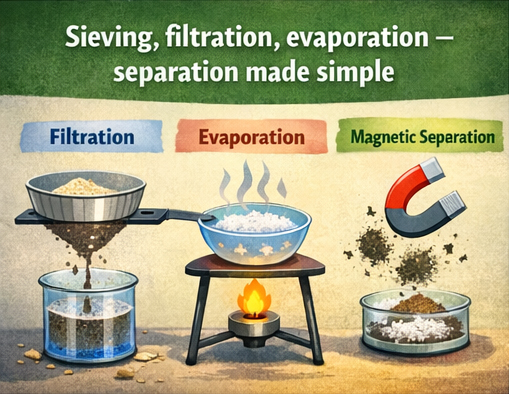
| Elements, Compounds & Mixtures | Element (made of identical atoms, symbols, metals/non-metals). Compound (two or more elements combined in fixed proportion, new properties – e.g., FeS). Mixture (components in any proportion, original properties retained). Differences between mixture & compound. Separation techniques: sieving, sedimentation, decantation, filtration, evaporation, magnetic separation (with examples) |
| Matter | States of matter – solid, liquid, gas (properties: shape, volume). Interconversion (ice → water → vapour). Effect of heat: expansion, change of state (melting, freezing, evaporation, condensation), chemical change (burning candle) |
🌿 BIOLOGY (Standard ICSE Class 6 – inferred for completeness)
| Topic | Key Concepts |
|---|---|
| The Living World | Characteristics of living things (growth, respiration, response, reproduction, excretion, nutrition). Difference between living & non-living |
| Classification of Plants | Herbs, shrubs, trees, climbers, creepers. Flowering & non-flowering plants (basic) |
| Plant Life | Parts of a plant: root (tap/fibrous, functions), stem (support, transport), leaf (photosynthesis, transpiration), flower (reproduction). Photosynthesis process (sunlight, chlorophyll, CO₂, water → glucose + oxygen) |
| Classification of Animals | Invertebrates (no backbone: insects, worms, spiders) vs Vertebrates (backbone: fish, amphibians, reptiles, birds, mammals). Basic features of each group |
| Human Body – Digestive System | Organs: mouth, oesophagus, stomach, small intestine, large intestine, liver, pancreas. Path of food, absorption, egestion |
| Human Body – Respiratory System | Breathing vs respiration. Organs: nose, windpipe (trachea), lungs. Exchange of gases (oxygen in, carbon dioxide out) |
| Health & Hygiene | Balanced diet & nutrients (carbohydrates, proteins, fats, vitamins, minerals). Deficiency diseases (scurvy, rickets, anaemia – basic). Cleanliness, exercise, rest |
One Program. Four Subjects. Complete ICSE Preparation.

Full Syllabus Coverage: Every Maths, Physics, Chemistry, and Biology topic prescribed by ICSE for Class 6 – no shortcuts, no omissions.
-
Conceptual, Not Rote: We teach why LCM×HCF works, how algebra generalizes arithmetic, why light travels in a straight line, how filtration separates mixtures, and what photosynthesis really means – using activities, experiments, and models.
-
Integrated Learning: We show connections between subjects (e.g., measurement in Physics uses Maths; separation techniques link to daily life).
-
Small Batches (Max 8-10): Personal attention for every child – whether they struggle with negative numbers or the digestive system.
-
Regular Assessments: Weekly topic tests + monthly parent progress reports for all four subjects.
-
Life Skills & Relevance: Real-world problems (money, time, speed, health, hygiene, magnetism) – so children see why they're learning.


Call to Action
Give Your Child the Complete ICSE Class 6 Advantage – Maths + Physics + Chemistry + Biology, Under One Roof
Don't juggle multiple tutors or settle for incomplete coverage. Enrol your child in our Combined Maths & Science Program and watch them grow into a confident, curious, and capable learner.
Limited seats available. First 10 enrolments get a free assessment & demo class.


